
Ottumwa Directory Shelves and Scans
Treat Ottumwa city directory research as a set of dated collections. Do not expect one unbroken run. FamilySearch catalogs McCoy's 1907-1908 directory and a 964-page Polk volume from 1969. The Library of Congress offers free images, PDFs, and OCR. These cover telephone reels spanning 1933 through 1961. For broader local-history material, the Ottumwa Public Library and the Wapello County Genealogical Society are the places to ask. Neither publishes its physical year runs online. Ask staff about the year you need rather than assuming every annual volume survives.
Directory work rewards patience. One dated book answers one question. A resident lookup across several volumes builds the fuller picture.
| Ottumwa collection | Dated coverage | Custodian | How to use it |
|---|---|---|---|
| McCoy's Ottumwa city directory | 1907-1908 | FamilySearch catalog | Catalog and item access rules apply |
| Polk's Ottumwa directory | 1969 | FamilySearch Books | Online catalog result; login or view rules may apply |
| White and Yellow Pages reels | 1933-1961 | Library of Congress | Free scans, PDF, and OCR online |
| Local directories and family files | Years not posted | Wapello County Genealogical Society | Visit, appointment, or research request |
| Newspaper microfilm | 1871-present, with early gaps | Ottumwa Public Library | In person or staff article lookup |
No named Ottumwa reverse or criss-cross directory series appears in the major catalogs. Telephone books, newspaper street notices, and staff lookups serve as the best substitutes. This gap matters: an alphabetical book should never be called street ordered unless its own index proves it.
Ottumwa Library Genealogy Help
The Ottumwa Public Library services page posts genealogy staff hours on Thursday and Saturday from 3:00 to 5:00 p.m. The library sits at 102 W 4th Street, and the phone number is 641-682-7563. Reference staff will retrieve a historical article or obituary by email at ref@ottumwapubliclibrary.org. That remote route works well when a directory name needs a dated newspaper check.
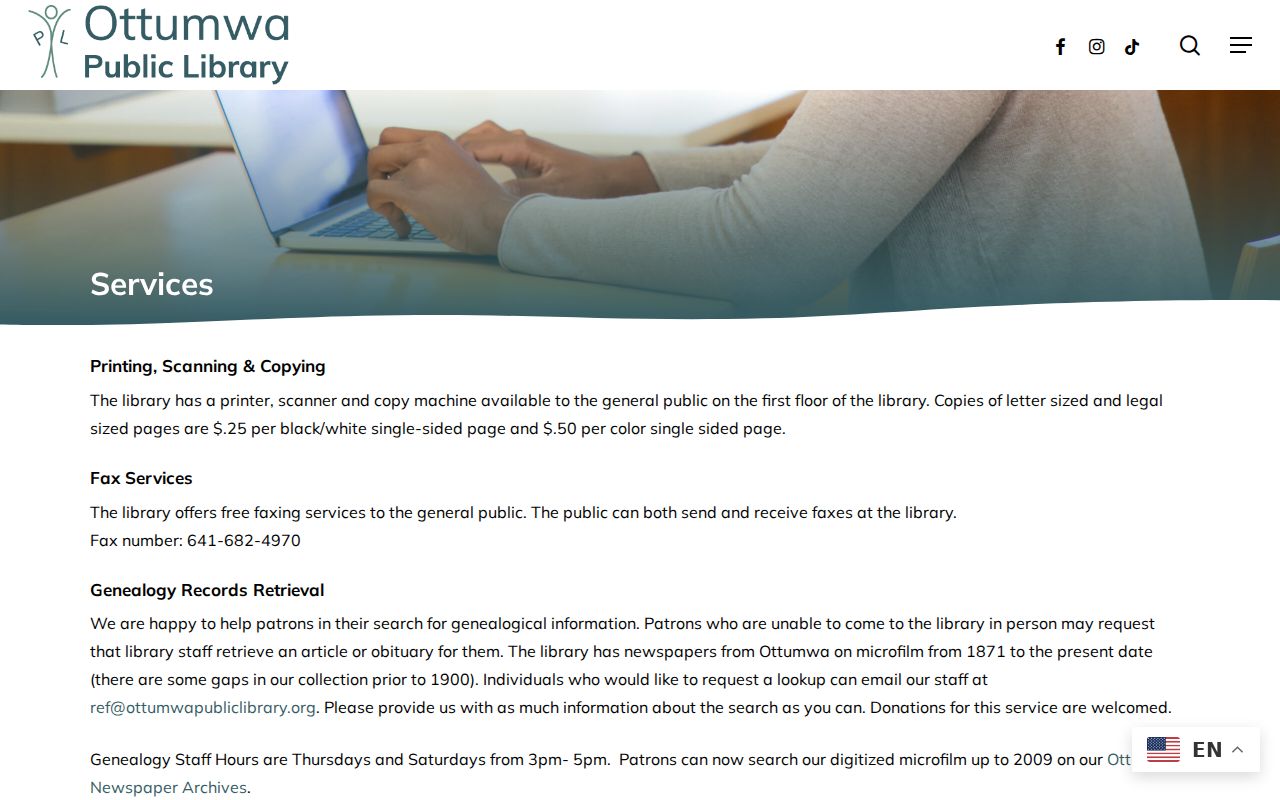
The library's services listing shows genealogy support reaching well beyond its online catalog. Public hours run Monday through Thursday, 9:00 a.m. to 6:00 p.m., and Friday through Saturday, 9:00 a.m. to 5:00 p.m., with Sundays closed. Bring a spelling, a date range, and a likely newspaper title to keep any request narrow.
McCoy and Polk Ottumwa Directories
Publisher and year belong in every citation. The FamilySearch catalog for McCoy's Ottumwa city directory identifies a 1907-1908 work, and a separate FamilySearch Books result lists Polk's 1969 Ottumwa and Wapello County directory as a 964-page volume. These are firm catalog points. They do not prove a complete annual series ran between them.
The catalog entry itself displays the route to McCoy's volume. Note the title, publisher, dates, and access status when saving a find. If full viewing is limited, ask the library or the Genealogical Society whether a local copy or lookup exists.
Ottumwa Directory Telephone Reels
The Library of Congress telephone collection offers the strongest continuous online run for Ottumwa: April 1933 through June 1943, followed by reels for 1944-1951, 1952-1956, and 1957-1961. A telephone city directory records subscribers and businesses. People without service or a listed number may not appear at all. Even so, the page images tie a dated name to a street and a phone exchange, which makes them a core residents directory source for those decades.
| Reel period | Best use |
|---|---|
| 1933-1943 | Early subscriber and business addresses |
| 1944-1951 | Postwar name and street changes |
| 1952-1956 | Mid-century household or business checks |
| 1957-1961 | Bridge to the later Polk volume |
OCR, or optical character recognition, turns a scan into searchable text. It can misread initials and short street forms. Search the OCR first. Then open the page image and cite the issue date and page.
Telephone books also split household evidence from business evidence. A subscriber line may name one person even when several relatives shared the home. A Yellow Pages trade listing may place a shop on the same street. Yet it says nothing about who slept there. Copy the heading and its label along with the name. That small step keeps a shop listing from being recast as proof of residence. Its owner may or may not have lived above or beside the business.
Reading an Ottumwa Directory Listing
A real April 1933 page, headed "FIS-GET / OTTUMWA," shows why page images matter. Fisher J A appears as "Res" at 1608 E Main. Fisher Sisters Grocery sits at 2313 E Main. Fleming Forrest L is listed as "Res" at 304 W 4. Foster Inn appears at 119 N Washington. Homes, shops, a hotel, and more all share one alphabetical sequence on that single page.
| Surname and given name | Alphabetical key, sometimes shown with initials |
|---|---|
| Type label | “Res” identifies a residence; a business name has a different meaning |
| Street line | House number plus period street form, such as “W 4” |
| Phone column | Subscriber exchange and number aligned at the page edge |
| Issue date | The point in time to which the entire listing belongs |
- Criss-cross directory
- A directory arranged by street or phone number instead of only by surname. No confirmed Ottumwa series was found.
- Householder index
- A street-based list of the named person associated with each address, when a volume includes one.
- Abbreviation key
- The volume's own guide to short labels. Save it before interpreting entries.
Ottumwa Newspapers Confirm Directory Clues
The library describes newspaper microfilm from 1871 to the present, with gaps before 1900. Its separate digital archive lists title-specific runs. These include the Ottumwa Daily Courier from 1867-1960 and the Ottumwa Courier from 1960-2025. Those overlapping labels should stay tied to their own collection records. They should not be merged into one invented span.
Search a surname with the street number, then try initials and old street abbreviations. An obituary or a school notice can explain a listing. So can an advertisement or civic item. It can show why a person or business appeared in that year's city directory. Always open the scan itself. OCR text is a lead; the printed page is the source to cite.
Ottumwa Genealogy Society Holdings
The Wapello County Genealogical Society sits at 102 E Main Street. Its shelves hold much of what an Ottumwa family historian wants. The collection spans city directories, school annuals, and obituaries from 1892 to the present. It also holds cemetery and burial files, census microfilm, church records, and family histories. Hours run Wednesday through Friday from noon to 3:30 p.m. Monday and Tuesday visits need an appointment.
Anyone can write to research@wapellocountygs.com, member or not. The society asks a reasonable per-hour donation. It publishes no full inventory of the directory years it holds. A good request names the person, the date band, the address, and the records already searched. That detail points the volunteer to the right shelf. It also avoids promises about a volume that may not exist.
The shelf itself beats online OCR for spelling variants. Nearby surnames, a widow notation, a spouse, or the abbreviation page all sit within reach of a slow browse. Ask for a citation or a scan of the exact page rather than a typed summary. The printed entry is far easier to lay beside another record.
Note: A photocopy or scan carries the directory's own typography. That makes mismatches with a census or deed record jump out quickly.
Ottumwa Students, Maps, and Archives
Argus Annuals cover the school years from 1903 to 1990. Portraits, clubs, class years, and activities appear in them. They cannot prove an adult address, though. IAGenWeb rounds out the picture with local histories plus cemetery, probate, census, school, church, map, and vital-record leads. Its transcriptions should always lead you back to the original record. The State Historical Society of Iowa digital resources open onto photographs, newspapers, and county atlases. Sanborn maps appear there too. Sanborn sets for Ottumwa exist for 1885, 1891, 1897, 1902, 1909, and 1917.
The state page opens a route into the catalog and its digital collections. A map gives you buildings and streets, not a resident name. Pair it with a dated directory or newspaper entry. That pairing matters before you conclude anything about a household.
Ottumwa's river, rail lines, and old Main Street axis supply further place context. The 2024 Historic Preservation Plan lists 24 National Register items. It also includes a dated local timeline. These records can explain a street or landmark name. Keep that building evidence separate from evidence about a named person. One does not prove the other.
Ottumwa Directory Record Timeline
Ottumwa's directory trail involves several record formats rather than a single leap from paper to digital. The dates below mark confirmed sources and local context.
- 1871: The library's described newspaper microfilm run begins, with some gaps before 1900.
- 1907-1908: McCoy Directory Company publishes the cataloged Ottumwa volume.
- 1933-1961: Library of Congress telephone reels cover subscribers and businesses.
- 1969: The 964-page Polk Ottumwa directory appears in the FamilySearch catalog.
- 2025: The digital archive's title listings extend the Ottumwa Courier run through this year.
These dates do not promise every year or every household. They simply show which dated source to seek next.
Trace Family Through Ottumwa Directories
A city directory can bridge the years between federal census schedules. Keep every listing in its own time and source context. A subscriber, student, business party, deed party, and cemetery record may all point to the same person, yet each one proves something different about that life.
- Choose the nearest available issue and search the full surname, initials, and likely business name.
- Copy the entry as printed, including “Res,” old street forms, phone number, page, and issue date.
- Move to the next confirmed volume or telephone reel and log every change without filling a missing year.
- Compare the dated listings with a census year, school annual, newspaper item, or cemetery file.
- Use the controlling custodian for the fact needed, such as the Recorder for a deed or vital-record office for a certified event record.
A disappearance in the record has many causes. A move, a death, a name change, or an unlisted telephone could all explain it. A publication gap or an OCR error could do the same. Test the next issue and the prior one. Then turn to library staff or the Genealogical Society. For a current address, the separate Ottumwa resident lookup workflow is the right tool. Do not treat an old listing as fact.